

Tips on How to Strategically ncorporate Plant Life Without Over cluttering

The Art of High-Density Greenery in Small Spaces
In the world of coastal design, we often talk about "bringing the outdoors in." But when square footage is at a premium, that transition requires more than just a single fern in a corner. It requires a curated composition—a way to layer life into your home so it feels like a lush sanctuary rather than a cluttered greenhouse.
At Raincoast, we believe in the Art of the Indoor Forest. Whether you have a sprawling sunroom or a 600-square-foot studio, here is how to master the greenery of your space.
1. The Small Space Strategy: Verticality & Layering
When floor space is finite, look up. The secret to having a "large quantity" of plants in a small area is visual layering.
- The Rule of Three Heights: Always group plants in clusters of three with varying heights: a floor plant (the anchor), a mid-level plant on a stool or side table, and a trailing plant on a shelf. This creates a "curtain of green" that fills the vertical void without eating your walkway.
- The Floating Forest: Use wall-mounted planters or ceiling hooks. In a small space, a trailing Pothos or String of Hearts hanging in front of a window acts as living lace, providing privacy and texture without the footprint of furniture.
2. The Potting Philosophy: Form Meets Function
A plant is only as beautiful as the vessel it inhabits. For a cohesive coastal vibe, stick to a palette of "Earthy Neutrals"—terracotta, stone, and matte ceramics.
- The Nursery Secret: Never plant directly into a decorative "cache" pot that lacks a drainage hole. Keep the plant in its plastic nursery pot and drop it into the decorative one.
- Pro Tip: To hide the plastic rim, top the soil with a layer of preserved moss or small river stones. It instantly elevates the look to a "designer" level.
Price Tiers for Pots (Avg):
- Budget ($5–$15): Classic Terracotta or IKEA’s Muskot series. Great for high-volume collections.
- Mid-Range ($20–$55): Glazed stoneware from local boutiques or West Elm. Look for matte finishes in sage, cream, or charcoal.
- Investment ($75+): Large-scale fiberstone or handmade artisan ceramics. Use these for your "Anchor" plants like a Fiddle Leaf Fig or a large Monstera.
To keep your collection thriving, you must respect the "Yin and Yang" of plant species.
3. Desert vs. Jungle: A Care Guide
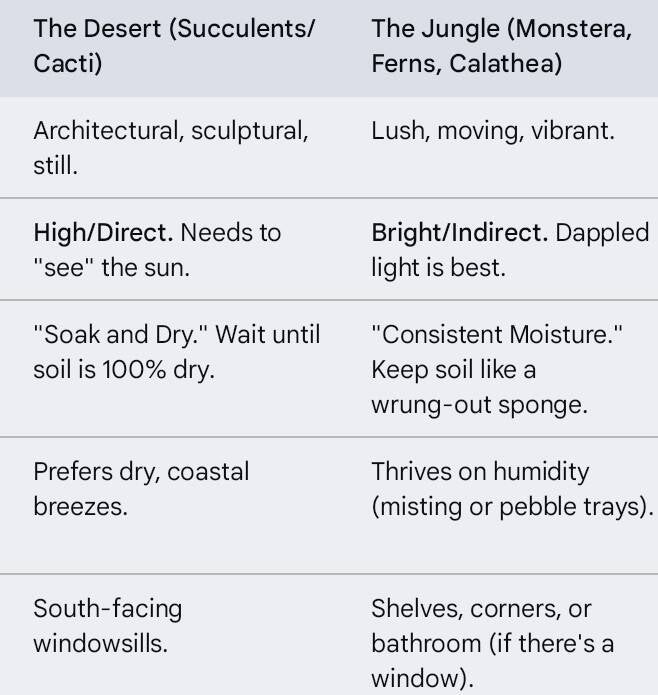

📸 Credit to Imaginima
4. Let There Be Light: Affordable Creative Options
Don’t let a dark corner limit your collection. Grow lights have evolved from purple "blurple" LEDs to beautiful, warm-spectrum design elements.
The Strip LED (Under-Shelf Magic): * Option: Barrina T5 Grow Lights. These are slim, white, and can be tucked under bookshelves or kitchen cabinets.
Price: ~$40–$60 for a pack of 6.
The Floor Lamp (The Spotlight): * Option: Use any stylish floor lamp (like a tripod or arched lamp) and swap the standard bulb for a GE Balanced Spectrum Grow Bulb. It looks like a normal warm light but feeds your plants.
Price: Bulb (~$15), Lamp (~$40+).
The Japanese Ball (The Glow): * Creative Idea: Take a Japanese Paper Lantern (Washi ball) and hang it in a corner. Instead of a dim mood bulb, use a high-lumen grow bulb. It diffuses the light beautifully, creating a soft moon-like glow that supports your "Jungle" plants underneath.
Price: Lantern (~$10), Cord kit (~$12), Bulb (~$15).
Final Thought: The Grounded Home
Whether you have fifty plants or five, the goal is the same: to create a space that breathes. Start with one anchor, add a few trailers, and let the light guide you. Your home isn't just a place to live; it's a living thing.
Post your photos below—I can't wait to see how you've styled your LED strips and Japanese Lanterns!

Create Your Own Website With Webador